INSIGHTS
Solving Healthcare's Silent Crisis: Why Provider Time Is the Most Valuable Resource in Medicine
by Dr. Michael Blackman, Chief Medical Officer, Greenway Health
Tuesday, February 10, 2026 @ 9:18 AM EST

I once spent 50 minutes on the phone trying to get a CT scan authorized for a patient with a known lung nodule. Serial imaging is standard of care in these cases. It’s not controversial or experimental. It’s just basic medicine. I wrote up the request, including the patient’s history and the last scan. Denied. I rewrote it, highlighting the relevant findings. Denied again.
So one afternoon, after seeing patients all day, I called the insurance company’s appeals line. I worked through multiple people and repeated the same clinical information. Fifty minutes later, I finally reached a radiologist who approved it in under five seconds. He even apologized for the nonsense.
That is the invisible waste in modern healthcare. Fifty minutes that could have been spent seeing patients, returning calls, or finishing notes before going home. Multiply that by thousands of clinicians, hundreds of days per year, and you begin to understand why we’re hemorrhaging the most valuable resource in medicine: provider time.
It’s Not Just the Doctors
Early in my career, I noticed that everything in medicine required a doctor’s signature. Physician notes were treated like gold: “The doctor needs to review this.” “The doctor needs to sign that.” It creates a bottleneck in which providers become overwhelmed with tasks that may or may not actually require their level of expertise.
But medicine is a team sport. Nobody can do this alone. Not the physician, not the nurse, not the medical assistant. The question is how to manage everyone’s time so each team member can work at the top of their capabilities.
I learned this lesson the hard way. About a year and a half into private practice, our front desk person retired. She had been there for 20 years, knew every patient by name, and understood their habits and proclivities. After she left, my schedule fell into chaos.
What I discovered was that she knew, without it being written down anywhere, that you didn’t put Mr. Smith and Mrs. Jones in the same half of the day because there was just no way you could get through it. That institutional knowledge and invisible coordination had kept the practice running smoothly, and when that disappeared, we all felt it.
What Documentation Really Is
People often call documentation a burden, but I try not to use that word. It is how we organize our thoughts about what happened and what we did. Many times, writing a note can help crystallize one’s thinking.
The real problem is that medical notes serve two contradictory masters. On one level, they are billing documents. On another, they are communication tools. You can write an excellent note from a billing perspective that tells other clinicians nothing useful. Or you can write a clinically clear note that’s inadequate for billing because you left out required elements.

If someone comes in with upper respiratory symptoms and I write, “28-year-old male with five days of URI symptoms, slight cough, no fever, no shortness of breath. Exam normal. Impression: URI, supportive care discussed,” any clinician would understand what I did, what I thought, and what comes next. The billing on that note would be awful. It needs a few more elements that I did not include.
That’s the tension we’re living with. EHRs solved illegible handwriting but introduced a new data entry burden. The question now is whether technology can help us extract the structure we need from good clinical documentation, rather than forcing clinicians to document in ways that do not match how we actually think.
What I Don’t Miss—And What I Do
I no longer see patients and don’t miss the treadmill. The need to see a new patient every 15 minutes and the constant feeling of being behind. What I do miss are the patient stories and that end-of-day feeling of having helped someone.
In my current role, I’m trying to practice medicine at a macro level. I focus on what could make clinicians’ lives better and, by extension, make practices and patients’ lives better. Patients do not want their doctor’s nose buried in the computer; they want to talk to the person taking care of them.
Technology That Serves, Not Demands
When I talk to clinicians about EHR systems, the first thing I ask is: How do you see patients? In what order do you like to go through information? There’s no universal answer. Some review labs first, then old notes, then radiology. Others follow a completely different pattern.
My goal is to understand how clinicians naturally structure information and then help align how they use the system to that existing framework. That is the opposite of forcing them to learn a new structure alongside new software.
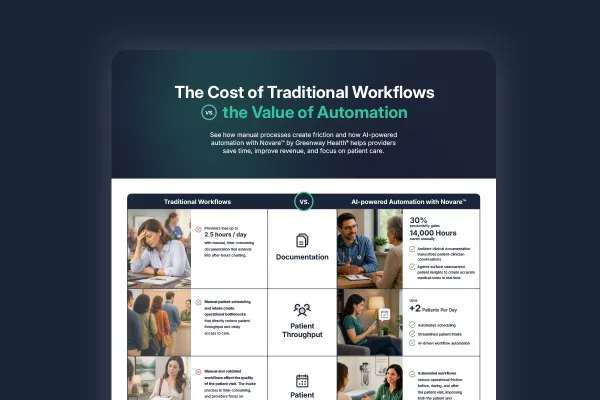
That’s the philosophy behind Novare™. Rather than adding more point solutions and clicks, the AI-enabled platform is designed to anticipate clinicians’ needs and handle routine coordination in the background. AI-generated patient summaries provide instant pre-visit context. Intelligent coding suggestions and real-time HCC reminders surface during the encounter. Prior authorizations begin processing the moment an order is placed.
The goal isn’t to replace human judgment; it’s to protect it. AI can surface patterns that would take tremendous effort to identify manually. For example, conditions that slowly reveal themselves over time, where multiple, often disconnected, data points need to be brought into a common focus. The system can help give a clinician the best chance to make a good decision.
But the ultimate responsibility remains with the clinician. AI is a tool that supports better decisions, but it doesn’t make them for you, and it shouldn’t.
Time Reclaimed
Practices that protect clinician time see lower turnover, fewer errors, stronger collaboration, and more predictable financial performance. When documentation happens seamlessly and routine tasks are automated, accuracy improves. When clinicians aren’t overwhelmed, patients notice.
Healthcare doesn’t need clinicians to care more. It needs technology solutions that stop wasting their time.
If we measure success not just in features deployed or tasks automated, but in minutes returned to care, we change the equation. Time reclaimed from documentation becomes time for listening. Time removed from rework becomes time for access. Time freed from after-hours burden becomes time that keeps clinicians in practice.
Provider time is medicine’s most valuable resource. It’s the foundation of quality, sustainability, and trust. And it’s time we started treating it that way.