The EHR Era Isn't Over. But It's Entering Its Next Chapter.

David Cohen
Chief Product and Strategy Officer
Tuesday, July 14, 2026 @ 12:56 PM EDT
EHRs aren’t becoming obsolete. But systems built primarily as records of care are reaching the limits of that design. The next stage of the EHR belongs to platforms that don’t just store what happened during a patient’s care—they help carry that care forward, with AI built in by design, not bolted on.
For two decades, electronic health records have been healthcare’s digital backbone. They turned paper charts into reliable digital records, making modern care delivery possible, and organizations built entire operating models around that capability. Measured against the goal set for them—to digitize the medical record—EHRs have been a success.
But running a thriving ambulatory practice demands far more than data capture. Orders and referrals need to be processed, codes need to be assigned, prior authorizations need to be initiated, claims need to be scrubbed, and a system designed mainly to record information was not built to move all of that work forward. So the work falls to people or to bolted-on tools, each bringing handoffs and additional coordination burden. Practices keep investing in optimization, but too often the daily experience does not meaningfully improve. That’s what a ceiling feels like from the inside.
Healthcare is ready for the next chapter: turning the record from a passive repository into an active participant in care delivery and practice operations.
Where the opportunity shows up
Most practice leaders don’t need a formal assessment to see where the opportunity is. The signs are visible in any clinic, in any week.
Clinicians finish their notes after the building has emptied. The pattern is common enough to have earned a name: the “second shift.” Staff move across half a dozen systems to complete a single prior authorization. Coders reconstruct context after the visit because the clinical details are no longer in the flow of work. And each new module added to solve one of these problems tends to introduce new clicks and handoffs rather than remove them.
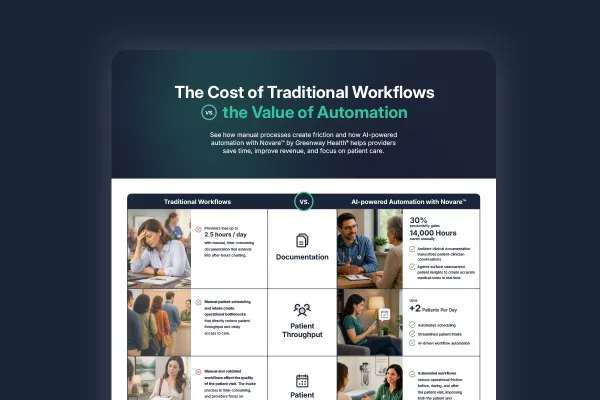
The numbers behind those scenes are significant. Ambulatory physicians spend an average of 5.8 hours actively working in the EHR for every 8 hours of scheduled patient time, much of it outside clinic hours. A meta-analysis covering more than 54,000 healthcare professionals associated EHR use with roughly 2.5 times higher odds of burnout. And hospitals and health systems lost an estimated $48 billion in 2025 to claim denials and uncollected payments—a figure that doesn’t capture the daily time drain inside ambulatory practices.
AI offers a different way to address this, not by asking people to work faster, but by allowing technology to take on more of the routine coordination work that slows practices down.
Why architecture matters in the AI era
For years, healthcare technology was measured by how many capabilities a platform could add. The more important question now is how those capabilities work together. AI is most useful when it operates across an entire workflow, drawing on a shared understanding of the patient, the practice, and the business of care. That requires more than a collection of individual tools. It requires an architecture built to connect information, decisions, and actions end-to-end.
This is where AI built into the platform differs from AI added on. When AI is layered onto a system that was not designed for it, each capability often brings its own integration point, data context, and handoff. Design AI into the foundation, and it can draw on the full context of an encounter and coordinate the work across it. Added-on AI can automate individual tasks. An AI-by-design platform can orchestrate the workflow that those tasks are meant to complete.

From automating tasks to orchestrating work
Much of the conversation about AI focuses on automating individual tasks. Those gains are real: ambient documentation, coding assistance, and conversational search all create meaningful efficiency. But the larger opportunity is orchestration.
The difference is in how the work moves. In most environments today, scheduling, documentation, coding, billing, and reimbursement run in sequence, each step waiting on the one before it. A platform designed with AI at its core can let those processes run in parallel instead—before, during, and after the visit. Before a visit, the system can verify eligibility and flag prior authorization requirements. During the visit, ambient documentation can capture the conversation, while assistive coding suggests codes and surfaces care gaps in real time. After the visit, claims can be scrubbed and routed for review or submission.
Point solutions can accelerate individual steps. Orchestration reduces the waiting, rework, and context loss between them.
What this looks like in practice
This is the thinking behind Novare™ by Greenway Health®, and a single routine encounter shows the difference better than any feature list.
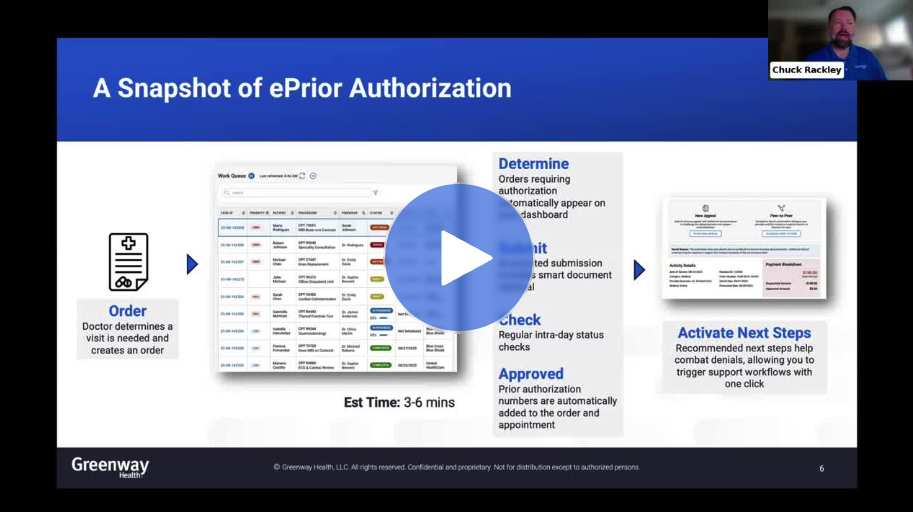
In a traditional workflow, the provider finishes the visit, and the downstream work begins: the note is finalized, codes are reviewed, prior authorization requirements are checked, and the claim is prepared. In an AI-by-design environment, much of that work can already be underway by the time the provider signs the note. An ambient documentation agent has drafted a structured note. An assistive coding agent has evaluated the encounter and suggested ICD, CPT, and HCC codes. The platform has checked whether an ordered medication requires prior authorization and, where it does, identified the supporting documentation needed to begin the process.
What makes that possible isn’t any single feature. It’s that the AI works within the encounter, with full context, across clinical and revenue-cycle workflows simultaneously. That is much harder to achieve when AI is added as another layer on top of disconnected workflow
The questions that matter now
Not long ago, practices evaluated EHRs on capabilities like e-prescribing, patient portals, and lab integration. Those still matter, but they no longer set one platform apart from another. The questions that do are architectural:
- Can the platform unify clinical, revenue cycle, and patient workflows on a single data model, or is it a set of disconnected tools stitched together?
- Is AI part of the foundation, or a third-party add-on that creates another silo?
- Can routine work move forward on its own with appropriate automation and exception-based review, or does every step still require a manual click?
A platform’s answers to those questions will reveal as much as any demo about whether it can change the way a practice actually works.
The next chapter
Healthcare leaders have every reason to be careful about sweeping technology promises. The industry has made them before, and practices have too often ended up with more complexity rather than less. That caution is well-earned.
What’s different now isn’t another set of features on the same foundation. It should be a different foundation for how work moves. And the proof isn’t in an architecture diagram—it’s in the daily experience. When physicians tell us a platform helps them be better doctors because they finally spend more time with patients than with their screens, that is the goal. That is what we’re hearing from Novare users.
The EHR era isn’t ending. It’s evolving. The next chapter belongs to platforms that don’t just capture what happened, but help shape what happens next.
About David Cohen
Chief Product and Strategy Officer
David Cohen, FACHE, is passionate about technology-driven solutions that help healthcare practices thrive. As Greenway’s Chief Product & Strategy Officer, he leads the company’s product vision, business strategy, and portfolio roadmap, ensuring innovation remains closely aligned with the evolving needs of ambulatory care providers and…
More by David Cohen