INSIGHTS
From Burden to Leverage: How Automation Is Rewriting the Economics of Ambulatory Care
By Richard Atkin, CEO, Greenway Health
Tuesday, February 17, 2026 @ 12:13 PM EST
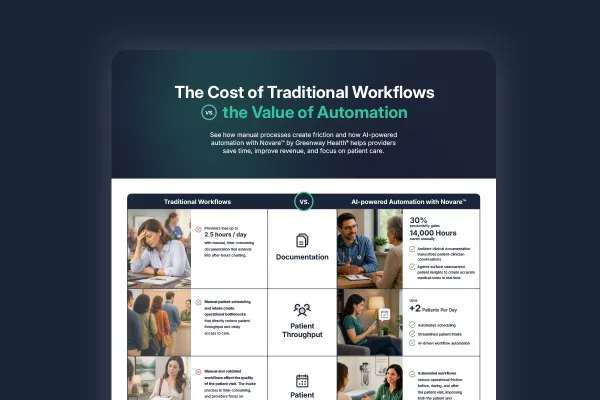
For decades, the economics of ambulatory care have been shaped less by the delivery of care and more by the work surrounding it. Clinicians and staff spend hours each day documenting, coding, reconciling data, and navigating payer rules. These activities are necessary for reimbursement, but they are largely invisible to patients and place a growing strain on practices.
Rising labor costs, persistent staffing shortages, and flat or declining reimbursement have turned administrative work into one of the largest drivers of cost in outpatient medicine. Margins are compressed not because clinicians are inefficient, but because the systems supporting care were never designed to operate at today’s level of complexity.
Technology has helped, but only incrementally. Too often, digital tools only allow teams to work faster inside the same broken model. However, the opportunity is much bigger than speed. It is a chance to fundamentally change how work gets done.
Moving Beyond Automation as Efficiency Only
Most healthcare organizations approach automation with a familiar goal: do the same work more quickly. Process claims faster. Schedule appointments with fewer clicks. Move information between systems with less manual effort.
This form of automation has value, but it does not change the underlying economics. It simply redistributes the same administrative friction across fewer minutes.
The more powerful question is different. What if automation didn’t just accelerate administrative tasks, but carried work forward on its own? What if systems could coordinate, decide, and act across workflows, rather than waiting for humans to push each step along?
This is the shift from automation to agentification.

What Agentic AI Makes Possible
Agentic AI moves beyond task execution. Instead of responding to prompts, it operates continuously, using context to anticipate what needs to happen next and coordinating actions across clinical and financial workflows.
When AI is embedded as core infrastructure, not layered on as a point solution, work begins to move differently. Documentation becomes a living input that informs coding, quality measures, and follow-up automatically. Prior authorizations initiate the moment an order is placed, not days later. Eligibility issues surface before patients arrive. Gaps in care and risk indicators are identified in real time, not discovered after the fact.
This is not about replacing clinicians or patient relationships. It is about enhancing human judgment by removing the invisible work that pulls attention away from patients. When systems handle coordination, clinicians can focus on care. When friction is reduced consistently, trust in technology follows.
Redefining Workflows, Not Just Tools
Healthcare technology has historically been built around documentation and billing, not orchestration. Simply layering AI onto that foundation can improve speed, but it cannot change the flow of work.
Agentic AI requires a different mindset. One where clinical and financial workflows are unified, data moves seamlessly, and intelligence is governed as an integral part of the system rather than treated as an aside.
This matters most for independent practices, which feel the weight of complexity more acutely than large health systems. Managing payer variation, value-based programs, staffing constraints, and patient access all at once is not sustainable without fundamentally rethinking how work is performed.
AI-by-design systems make it possible to manage complexity without adding proportional headcount. They enable practices not just to survive margin pressure, but to build resilience and scale thoughtfully.

From Cost Containment to Competitive Advantage
The true promise of Agentic AI is not efficiency or cost reduction alone. It is leverage.
When routine coordination happens automatically, accuracy improves. When documentation, coding prompts, and quality measures are aligned by design, revenue capture becomes more predictable. When clinicians are less overwhelmed, patient experience improves. When time is returned to care, practices retain talent and strengthen trust.
These gains come from changing the operating model itself, not from optimizing the edges of an already strained system.
At Greenway Health®, we believe the future of ambulatory care depends on technology that enables human-centric care at scale. Systems that fade into the background because they work. Platforms that give clinicians more time for care and help independent practices thrive in an increasingly complex environment.
Agentic AI, embedded natively into the core system of record, represents a turning point. Not incremental improvement, but a redefinition of how healthcare operates.
The organizations that embrace this shift will be better positioned to sustain quality, support clinicians, and build long-term economic resilience.