Healthcare organizations are asking harder questions about their EHR investments—not just what a system does, but what it costs when it doesn’t align with how care teams actually work and support change.
Are you replacing your EHR or rethinking how work gets done?
For most healthcare organizations, those are two fundamentally different conversations. Replacing a system means swapping the technology and hoping the outcomes follow. Rethinking how work gets done means examining the workflows, the friction points, and the daily accumulation of tasks that were never supposed to be clinical work. The second conversation is harder, but it’s the one that actually moves the needle. Simply replacing your EHR alone doesn’t typically produce the desired results.
What’s wrong with the way most EHR evaluations are conducted?
There’s a pattern that plays out in EHR evaluations more often than it should. The people building the comparison checklist usually aren’t the ones finishing documentation after hours. As a result, evaluation criteria drift away from how care actually moves through a day, or how one desires it to flow, and organizations end up replacing one inefficient workflow with another wrapped in a newer interface.
The practices that get real value from a technology transition start somewhere else. They map where time is actually going, where providers are spending hours they shouldn’t be, where revenue is leaking, and what staff genuinely need to do their jobs without working around the tools meant to support them. That shift, from features to outcomes, is what separates a meaningful evaluation from an expensive one.
What does EHR ROI actually look like for an ambulatory practice?
The business case for a stronger EHR is often framed around revenue cycle performance: reducing denials, accelerating reimbursement, and improving claims accuracy. But the most meaningful impact often comes from the operational and human costs that are harder to quantify.
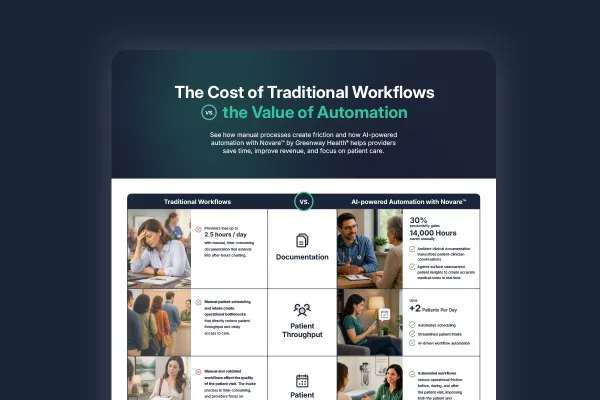
Consider the math. In a pilot program with a 10-provider ambulatory practice, Novare™ by Greenway Health® returned up to five hours per provider per day previously consumed by documentation, re-entry, and workarounds—adding up to more than 14,000 hours a year that weren’t going toward patients or revenue*. When a physician finishes clinic and spends the next two hours finishing notes, that’s not an inconvenience; it’s a clinical risk, a staff retention risk, and a quality-of-life problem that drives good people out of medicine. When evaluating any platform, ask vendors to provide a specific number for documentation time savings, not a range, and ask how they measure it, whether it’s tracked after implementation, and whether they can share outcomes from practices comparable in size and specialty.
The compounding effect on revenue is just as significant. Practices that have eliminated documentation gaps, automated coding workflows, and streamlined billing continuity have seen up to $1M in revenue cycle improvements, not from adding resources, but from removing the friction that quietly erodes reimbursement over time. Redesigning how work flows can also unlock capacity without adding headcount: up to an estimated 6,000 additional visits per year become possible when scheduling, prior authorization, and administrative follow-up no longer fall on clinical staff*.
A complete ROI evaluation accounts for all of it: clinical time recovered, administrative burden reduced, staff hours redirected toward patient-facing work, recovering after-hours time (“pajama time”), and revenue protected from documentation gaps and billing delays that quietly compound over time. If a vendor can’t connect their platform to those outcomes, with real data from practices like yours, that’s a signal worth taking seriously.
What should you look for in an EHR beyond the feature list?
The most revealing questions in an EHR evaluation aren’t about features. They’re about how data moves.
Does clinical information captured during a visit flow directly into coding and billing, or does someone have to touch it again? Is AI embedded in the platform’s core architecture, or was it acquired and layered on top, creating the handoffs and translation points that erode whatever efficiency it was intended to deliver? Can a workflow run continuously from pre-encounter through payment posting without the care team ever leaving the system?
Ask vendors to walk through a full patient encounter, from scheduling to payment, in a live environment. Count the context switches. That number will tell you more than any feature list.
What should you expect from an EHR vendor after go-live?
The technology decision and the vendor relationship decision are connected, but they aren’t the same thing. A strong platform with weak support will struggle to deliver results. A responsive vendor can’t fully compensate for technology that creates friction at every step. The difference becomes most visible after go-live, when the reality of daily operations sets in.
That’s why the most important questions extend beyond implementation. What does vendor support look like six or twelve months after launch? How does the vendor measure success, and what happens when outcomes stall or workflows still aren’t improving? How does the partnership and system evolve as the practice grows, payer requirements shift, and new regulations emerge?
For many organizations, those questions start surfacing long before an official EHR evaluation begins. They show up in leadership discussions, provider frustration, staff turnover, and mounting workflow inefficiencies.
Ask Any EHR Vendor—Including the One You Already Have.
To start that evaluation, download the guide:
It’s a practical framework that helps practices cut through the demo, pressure-test any platform, and identify what’s actually costing them time and revenue.
Greenway Health built Novare because those questions deserve real answers. Novare is a fully integrated clinical and revenue cycle platform powered by agentic AI that returns up to five hours per provider per day, unlocks thousands of additional visits per year, and drives up to $1M in revenue cycle improvements.*
*Results based on a 10-provider practice with 15 staff members, $4.6M in annual revenue, and 46-48K encounters/year.